-
Get Free Consulting: 08048250178
-
Shop No 5, Dev Siddhi Apt, Opp Hypercity Mall, Kasarvadavli, Ghodbunder Road, Thane West

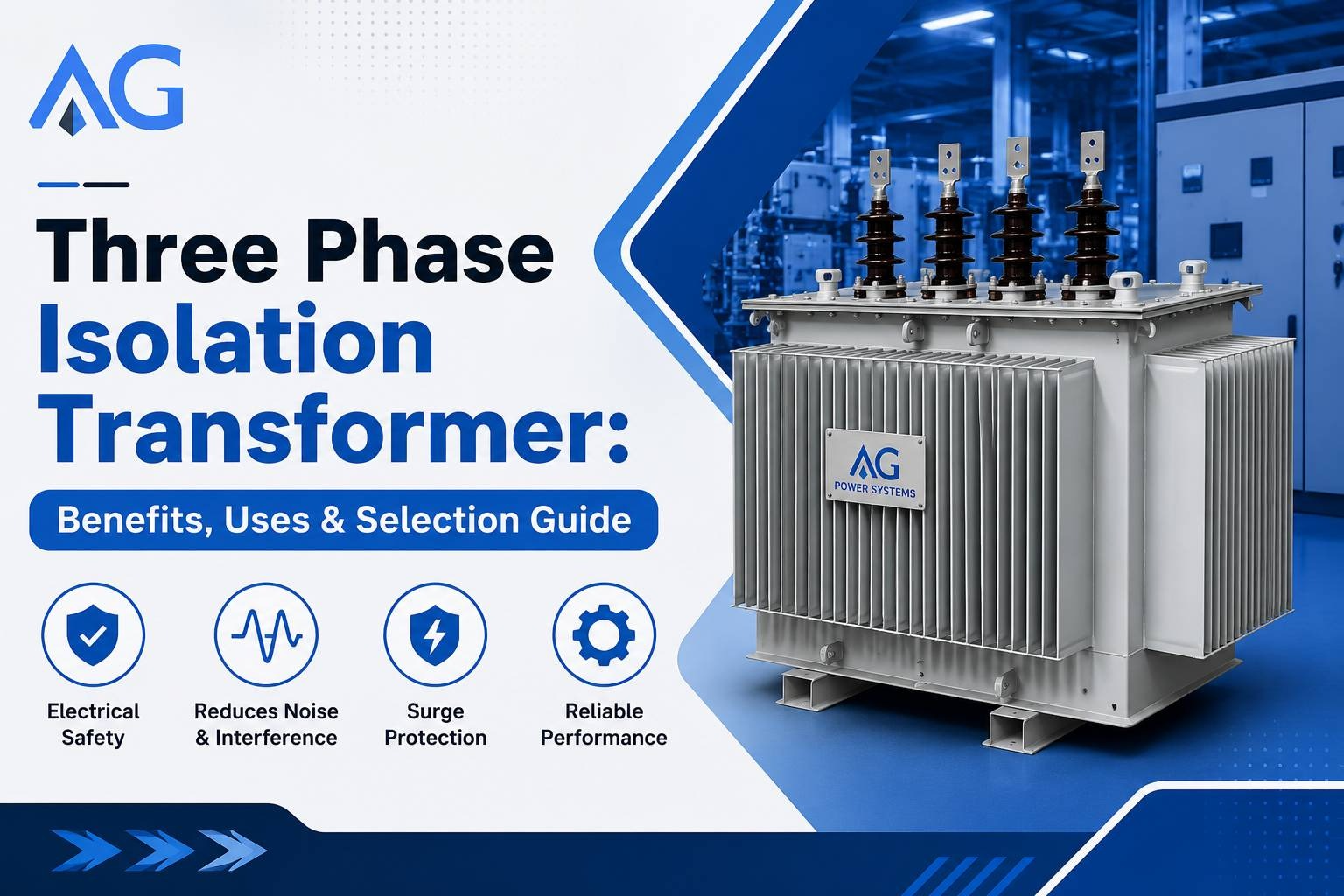
If your facility runs sensitive electronics, VFDs, medical equipment, or IT infrastructure alongside heavier industrial loads, you've probably run into a problem that's hard to pin down: unexplained resets, flickering displays, data errors, or components that fail earlier than they should. Often, the cause isn't the equipment itself — it's electrical noise and lack of isolation on the supply line.
A three phase isolation transformer in Thane is the standard solution for exactly this problem. It doesn't regulate voltage the way a stabilizer does — instead, it separates your equipment from the raw incoming supply, cutting out electrical noise, common-mode interference, and a layer of shock risk that a straight electrical connection can't avoid.
We've been manufacturing and supplying isolation transformers, servo stabilizers, static stabilizers, and UPS systems from Thane since 1998. This guide covers exactly what a three phase isolation transformer does, how it works, where it's used, and how to choose the right capacity for your facility.
What Is a Three Phase Isolation Transformer ?
A three phase isolation transformer is an electrical device that transfers power from its primary winding to its secondary winding using magnetic coupling only — with no direct electrical connection between the two. This creates galvanic isolation, meaning the equipment on the output side is electrically separated from the raw supply, which reduces shock risk and blocks common-mode electrical noise from passing through.
Most industrial isolation transformers use a 1:1 transformation ratio (output voltage matches input voltage), though step-up or step-down ratios are also available depending on the application.
How Does an Isolation Transformer Work ?
An isolation transformer works through electromagnetic induction — the primary winding creates a magnetic field that induces voltage in a separate, unconnected secondary winding, transferring power without a direct electrical path between input and output.
Because the two windings are only magnetically coupled and not electrically connected, the transformer :
- • Blocks a direct electrical path between the source and the load
- • Filters out common-mode noise and high-frequency interference riding on the supply line
- • Provides a clean, independent reference ground on the secondary side for sensitive equipment
- • Protects downstream equipment from certain classes of surges and transients originating upstream
What Are the Benefits of an Isolation Transformer ?
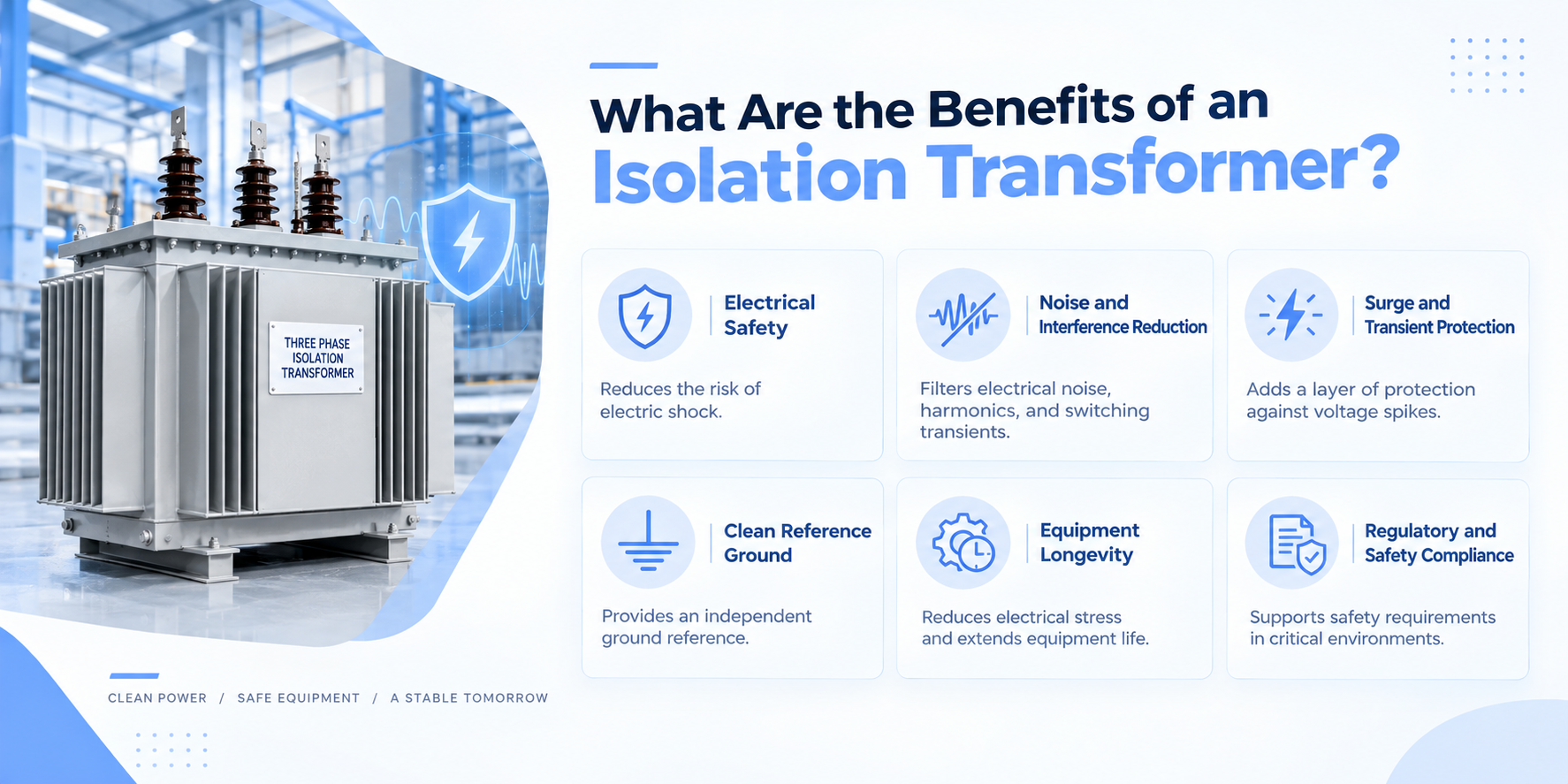
The core benefits industrial and commercial users get from a properly specified isolation transformer :
- • Electrical safety - reduces the risk of electric shock by removing the direct electrical connection between supply and load
- • Noise and interference reduction - filters common-mode noise, harmonics, and switching transients from reaching sensitive equipment
- • Surge and transient protection - adds a layer of protection against voltage spikes originating on the supply side
- • Clean reference ground - provides an independent ground reference, useful for sensitive electronic and measurement equipment
- • Equipment longevity - reduces the cumulative electrical stress that shortens the life of sensitive components
- • Regulatory and safety compliance - supports safety requirements in environments like healthcare facilities where patient-connected equipment needs isolated supply
Does an Isolation Transformer Reduce Electrical Noise ?
Yes. Because the primary and secondary windings are only magnetically coupled and not electrically connected, an isolation transformer blocks common-mode electrical noise and high-frequency interference from passing from the supply side to the load side, which is one of its primary functions alongside safety isolation.
This is especially valuable where :
- • VFDs (variable frequency drives) generate harmonic distortion that can feed back into the supply
- • Multiple pieces of sensitive equipment share a supply with heavier industrial machinery
- • Data and measurement equipment need a clean, low-noise power reference to function accurately
Isolation Transformer vs. Normal Transformer: What's the Difference ?
This is one of the most common questions we get, because the two look similar but solve different problems.
| Factor | Isolation Transformer | Normal (Step-Up/Down) Transformer |
|---|---|---|
|
Primary purpose
|
Electrical isolation, noise filtering, safety | Voltage conversion (step-up or step-down) |
|
Winding ratio
|
Usually 1:1 (same input/output voltage) | Varies based on required conversion |
|
Electrical connection
|
No direct connection between windings | May share design elements, focus is voltage change |
|
Noise filtering
|
Built-in benefit of isolation | Not a primary design goal |
|
Typical use case
|
Sensitive electronics, medical, data centers | General voltage step-up/down applications |
Where Are Three Phase Isolation Transformers Used ?
We supply three phase isolation transformers across a range of settings, including :
- • Industrial equipment — protecting VFDs, PLCs, and automation panels from noise generated by heavier machinery sharing the same supply
- • Data centers and IT infrastructure — providing clean, isolated power to servers and networking equipment where noise and grounding issues can cause data errors or hardware faults
- • Medical equipment — hospitals and diagnostic facilities where patient-connected equipment requires isolated supply for safety compliance
- • Commercial and institutional buildings — protecting building management systems and shared electrical infrastructure from cross-equipment interference
- • Process and automation lines — isolating control circuits from power circuits to prevent noise-related faults
How Do You Choose an Isolation Transformer Capacity ?
Total the connected load (in kVA) of all equipment that will run through the transformer, factor in inrush current for any motor-driven or capacitive loads, and add a safety margin so the transformer isn't running at its rated ceiling under normal operation.
The step-by-step approach we recommend :
- • List every load that will be isolated through the transformer — control panels, servers, medical devices, VFDs, or other sensitive equipment.
- • Calculate total kVA for the combined load, based on equipment nameplates rather than estimates.
- • Check for motor or capacitive loads on the circuit, since these draw higher inrush current at startup and need to be accounted for separately.
- • Confirm your phase configuration and voltage requirement — three phase isolation transformers are commonly available across a range of capacities and can be configured for different winding arrangements (e.g., Delta-Delta, Wye-Wye) depending on your system.
- • Add a safety margin, typically 20–25% above calculated load, to leave headroom for future additions.
- • Confirm environment and mounting requirements — indoor/outdoor placement, enclosure type, and cooling method all affect the right specification.
- • Get a site-specific recommendation rather than relying on a generic catalog rating, since isolation transformers are frequently built or configured to match a facility's specific load and layout.
Since isolation transformers are often a customized item based on your input voltage, phase configuration, and load profile, the most reliable way to finalize a spec is a short technical consultation rather than picking a number off a datasheet.
Common Mistakes to Avoid When Choosing an Isolation Transformer
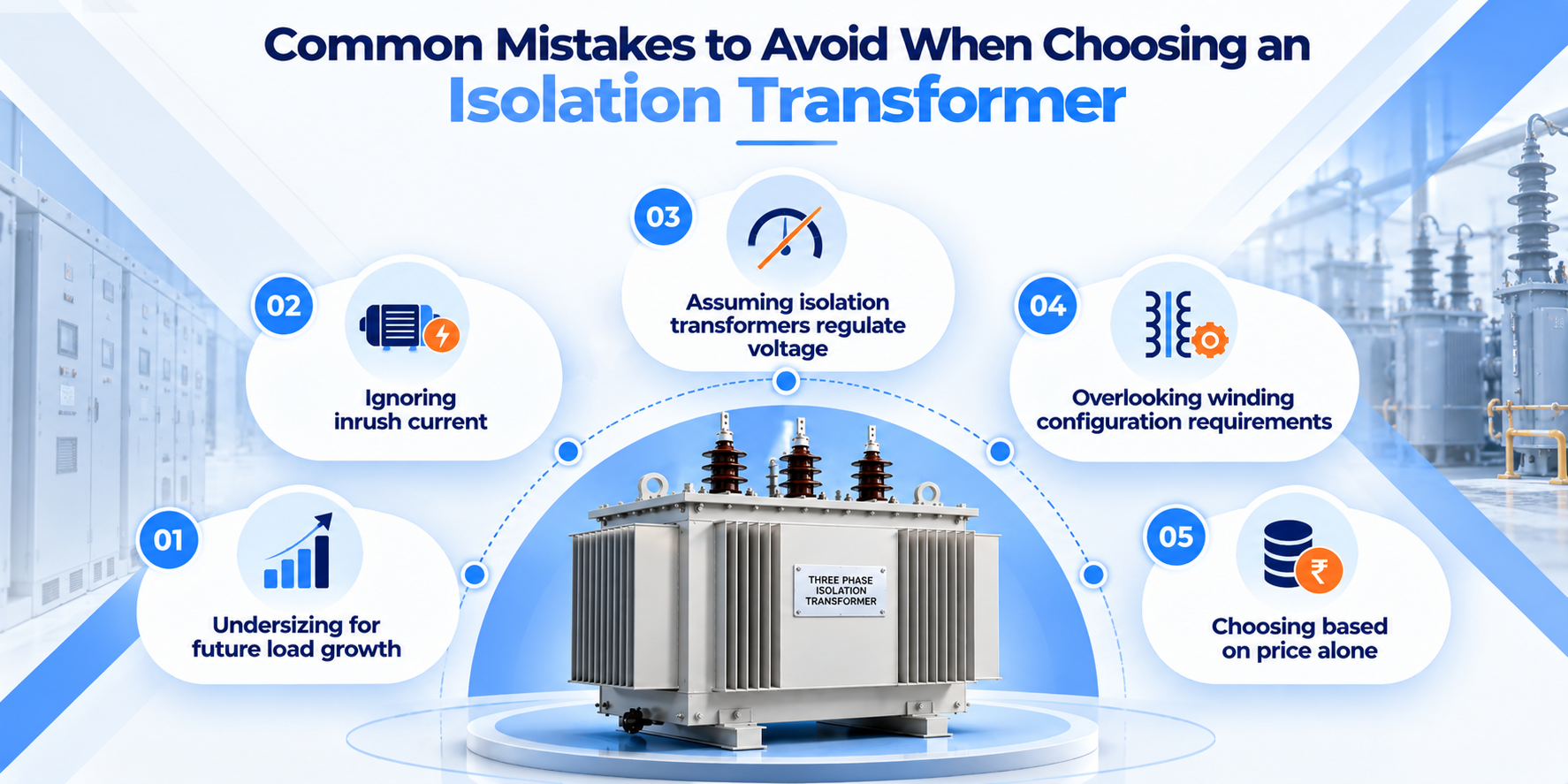
Based on our experience specifying these units for industrial and commercial clients :
- • Undersizing for future load growth, leaving no headroom as more equipment is added
- • Ignoring inrush current from motor-driven or capacitive loads, leading to nuisance tripping or premature wear
- • Assuming isolation transformers regulate voltage — they isolate and filter noise; they don't correct voltage fluctuations the way a servo stabilizer does (the two are often used together, not interchangeably)
- • Overlooking winding configuration requirements for the specific equipment being protected
- • Choosing based on price alone, without checking build quality, insulation class, or after-sales support
Why Choose AG Power Systems ?
AG Power Systems has operated out of Thane, Maharashtra since 1998, supplying industrial and commercial clients with isolation transformers, servo stabilizers, static stabilizers, and UPS systems. Because power quality issues rarely look the same at two different sites, our transformers are specified around your actual load, phase configuration, and environment rather than sold as a fixed catalog item.
If you're comparing options for a three phase transformer supplier in Thane, our team can review your site's equipment and noise concerns and recommend an appropriately built isolation transformer rather than a generic one-size-fits-all unit.
Conclusion
A three phase isolation transformer solves a specific problem: it protects sensitive equipment from electrical noise, provides a layer of shock protection through galvanic isolation, and gives you a clean reference ground where it matters most — medical facilities, data centers, and industrial control systems sharing power with heavier machinery. Getting the capacity, winding configuration, and safety margin right up front means the transformer quietly does its job for years, rather than becoming a bottleneck or a repeat support call.
If you're currently evaluating a three phase isolation transformer in Thane for your facility, our team can assess your load and recommend the right specification — reach out for a free consultation.
Frequently Asked Questions
A three phase isolation transformer is an electrical device that transfers power between primary and secondary windings using magnetic coupling only, with no direct electrical connection, providing galvanic isolation between the supply and connected equipment.
It works through electromagnetic induction — the primary winding generates a magnetic field that induces voltage in a separate secondary winding, transferring power without a direct electrical path, which blocks noise and reduces shock risk.
Key benefits include improved electrical safety, reduced electrical noise and interference, added surge protection, a clean independent reference ground, and longer equipment life for sensitive electronics.
Common applications include industrial equipment and VFDs, data centers and IT infrastructure, medical equipment, commercial buildings, and control circuits on automation and process lines.
Yes — because the windings are only magnetically coupled and not electrically connected, isolation transformers filter common-mode noise and high-frequency interference before it reaches connected equipment.
Total your connected load in kVA, account for inrush current from motor or capacitive loads, confirm phase and voltage requirements, and add a 20–25% safety margin. A site assessment gives the most accurate final spec.
A normal transformer is primarily built to step voltage up or down, while an isolation transformer is primarily built to electrically isolate and filter noise, typically with a 1:1 winding ratio.