-
Get Free Consulting: 08048250178
-
Shop No 5, Dev Siddhi Apt, Opp Hypercity Mall, Kasarvadavli, Ghodbunder Road, Thane West

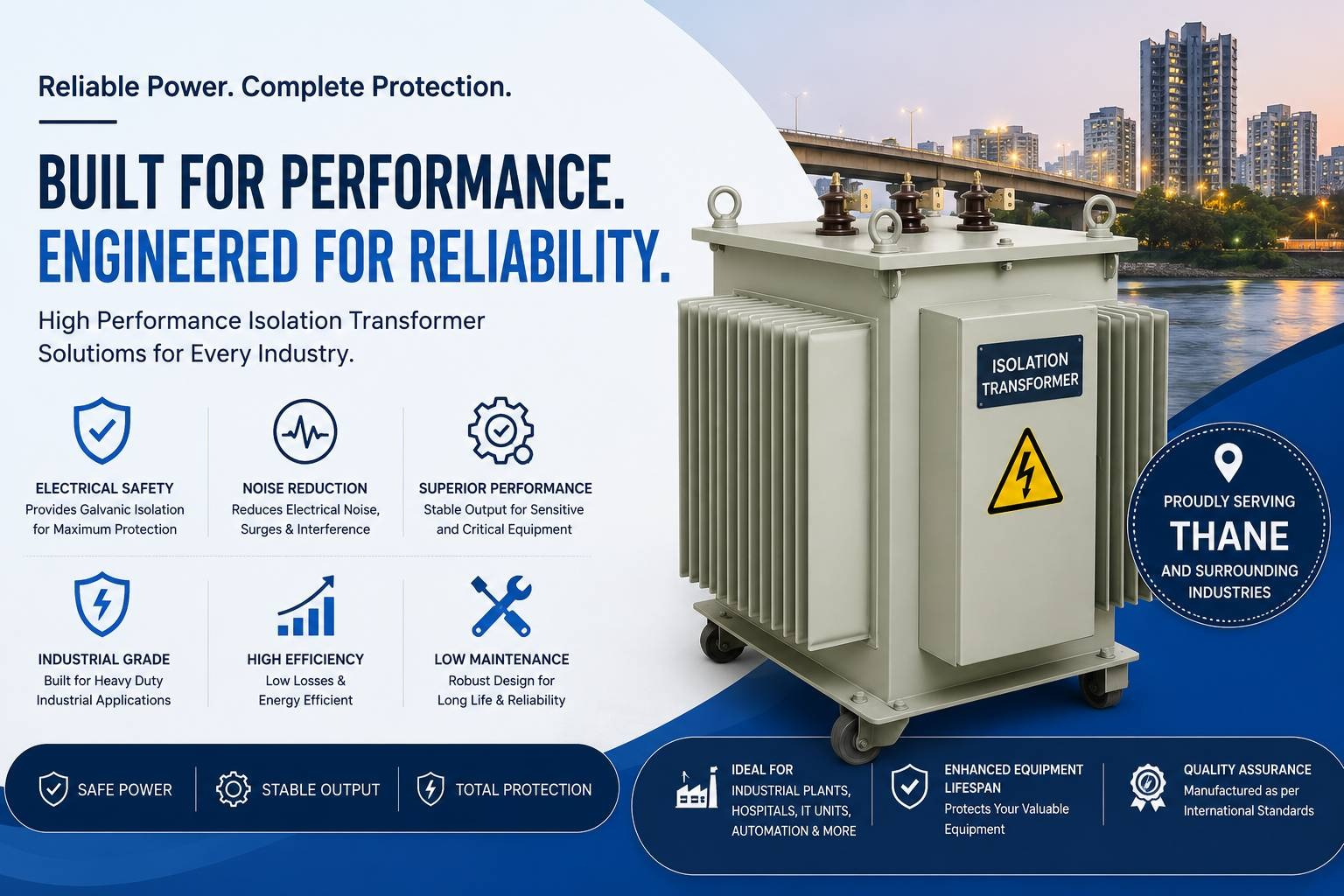
If your facility runs CNC machines, medical equipment, servers, or any electronics sensitive to electrical noise, you've probably run into a problem that's hard to diagnose: unexplained equipment glitches, shocks from metal casings, or premature component failure — even when your voltage looks "normal" on paper. In many cases, the real issue isn't voltage at all. It's grounding faults and electrical noise travelling straight from the power line into your equipment. This is exactly what a three phase isolation transformer is built to stop.
We've been manufacturing and supplying power equipment out of Thane, Maharashtra since 1998, and one of the most common products we're asked to explain — and supply — is the three phase isolation transformer in Thane for industries that simply can't afford electrical interference. This guide breaks down what it is, how it works, where it's used, and what to check before buying one.
What Is a Three Phase Isolation Transformer ?
A three phase isolation transformer is a stationary electrical device that separates the primary and secondary windings, creating complete physical and electrical isolation between the power source and connected equipment. It transfers electrical energy through magnetic induction rather than a direct wire connection, protecting sensitive loads from voltage spikes, electrical noise, and grounding faults.
Unlike a standard step-up or step-down transformer, an electrical isolation transformer isn't designed to change voltage levels — its core job is to seclude the input and output circuits from each other, so faults on the supply side never reach your machinery.
How Does an Isolation Transformer Work ?
Here's the short, step-by-step version :
- 1. Magnetic Induction - Power enters the primary winding and creates a magnetic field, without any direct electrical connection to the secondary winding.
- 2. EMF Generation - This magnetic field induces an electromotive force (EMF) in the secondary winding, transferring energy while maintaining the same frequency.
- 3. Isolation - Because the two windings are only magnetically linked, faults, spikes, and noise on the primary side are blocked from reaching the secondary (load) side.
- 4. Clean Output - The connected equipment receives stable, noise-free power, with reduced ground loop interference.
This is why a properly designed industrial isolation transformer is often paired with servo stabilizers, UPS systems, and sensitive lab or medical equipment — it forms the first line of defense against electrical faults.
Why Electrical Noise and Grounding Faults Matter More Than You Think ?
Many businesses focus only on voltage stability and overlook a quieter, equally damaging problem: electrical noise. Left unaddressed, it can :
- • Interfere with sensitive electronics, causing data errors or equipment malfunction
- • Create ground loop issues, leading to inconsistent readings in lab or measurement instruments
- • Increase shock hazards for personnel working near improperly grounded equipment
- • Shorten the life of transformers, PLCs, and control panels
- • Cause capacitive coupling problems, degrading signal quality in precision equipment
In our experience supplying power equipment across Thane and the wider Maharashtra region, industries running data centers, laboratories, and hospitals see the most benefit from installing a dedicated power isolation transformer early — rather than troubleshooting mysterious equipment failures later.
Key Features to Look For in a Three Phase Isolation Transformer
Based on nearly three decades of manufacturing experience, here's what genuinely matters when specifying one :
| Feature | Why It Matters |
|---|---|
|
Electrical Isolation
|
Separates primary and secondary circuits, preventing surges from reaching your equipment. |
|
Noise Reduction
|
Eliminates electrical noise that disrupts sensitive electronic devices. |
|
High Efficiency & Low Loss
|
Reduces power losses and improves overall system reliability. |
|
Robust Construction
|
High-grade MS angles and CRCA MS sheets ensure long-term durability. |
|
Overload Protection
|
Safeguards connected appliances from overload and short-circuit damage. |
|
Air-Cooled Design
|
Improves performance consistency and extends operational lifespan. |
|
Common Mode Noise Attenuation
|
Typically rated around 100 dB, minimizing interference at the source. |
Standard specifications for a three phase transformer of this type include ratings from 40 KVA to 1000 KVA (with 1–20 KVA options for single-phase), an input voltage of 415V AC ±10%, a 1:1 input-output voltage ratio, and a Delta/Star winding configuration. Since these units are typically built to order, exact specifications should always be matched to your facility's actual load and grounding conditions.

Applications : Where Is an Industrial Isolation Transformer Used?
A three phase isolation transformer is used wherever electrical noise or grounding faults could compromise safety or equipment performance :
Factories running heavy machinery need consistent, isolated power to prevent voltage spikes from damaging connected equipment.
Servers and networking hardware are highly sensitive to electrical disturbances. An isolation transformer minimizes power noise and improves system uptime.
Hospitals depend on uninterrupted, noise-free power for diagnostic and life-support equipment, making isolation transformers a safety essential rather than an optional upgrade.
Office buildings and commercial complexes use isolation transformers to protect computers, networking equipment, and other electronics from interference.
Benefits of Installing a Three Phase Isolation Transformer
- • Prevents electrical shocks by isolating circuits from the power source
- • Reduces electrical noise, improving the performance of connected equipment
- • Enhances equipment lifespan through stable, clean power output
- • Protects against voltage spikes and surges before they reach sensitive loads
- • Supports diverse applications, from heavy industrial use to commercial offices
These benefits become especially clear in facilities where "unexplained" equipment issues have persisted for months — often, the root cause turns out to be electrical noise rather than a faulty machine.
Common Mistakes Businesses Make When Buying an Isolation Transformer
After years of supplying these systems, we consistently see a few avoidable errors :
- • Confusing it with a step-down transformer - an isolation transformer is about isolation, not voltage conversion, and buying the wrong type solves nothing
- • Ignoring the KVA rating - undersized units get overloaded, while oversized units waste money
- • Overlooking construction quality - enclosures built from low-grade sheet metal corrode faster and reduce transformer life
- • Skipping the noise attenuation spec - a low dB rating means the unit won't meaningfully reduce interference
Our recommendation: always confirm your load profile, grounding setup, and sensitivity of connected equipment with your supplier before finalizing a transformer specification. A three phase isolation transformer is a long-term investment in equipment safety, and correct sizing prevents costly rework later.
Isolation Transformer vs. Servo Voltage Stabilizer: What's the Difference ?
| Parameter | Isolation Transformer | Servo Voltage Stabilizer |
|---|---|---|
|
Primary Function
|
Electrical isolation & noise reduction | Voltage correction |
|
Voltage Ratio
|
Typically 1:1 | Variable, corrects fluctuations |
|
Best For
|
Noise-sensitive electronics, grounding faults | Voltage instability, motor protection |
|
Often Used Together
|
Yes — isolation transformer feeds a clean, stable neutral into the stabilizer | Yes |
Many industrial setups actually benefit from both — the isolation transformer handles noise and grounding safety, while the stabilizer manages voltage correction.
Why Choose AG Power Systems ?
We've been engineering power solutions from Thane, Maharashtra since 1998, supplying batteries, servo stabilizers, static stabilizers, isolation transformers, UPS systems, and inverters to industries across the region. Every three phase isolation transformer we build uses MS angle and CRCA MS sheet enclosures, finished through a seven-tank pre-treatment process, primer coating, and two final coats of paint or powder coating for long-term durability.
Our isolation transformers are built with :
- • Air-cooled design for consistent performance
- • Delta/Star winding configuration
- • Common mode noise attenuation of approximately 100 dB
- • Overload and short-circuit protection
- • Customization based on your specific voltage and load requirements
With nearly three decades in the power solutions industry, we focus on precision engineering and dependable after-sales support — because when it comes to isolating sensitive equipment from faults, there's no room for shortcuts.
Conclusion
A three phase isolation transformer protects your equipment from a problem most businesses never see coming: electrical noise and grounding faults that quietly damage sensitive machinery over time. Whether you're running a data center, hospital, laboratory, or manufacturing unit, isolating your load from the power source is one of the most effective ways to extend equipment life and improve safety.
If you're evaluating a three phase isolation transformer in Thane or anywhere across Maharashtra, our team can help you specify the right KVA rating and configuration for your exact setup.
Frequently Asked Questions
It's a stationary device that separates primary and secondary windings, transferring power through magnetic induction rather than direct connection — isolating equipment from voltage spikes, noise, and grounding faults on the supply side.
It isolates the load from the power source, blocking electrical faults from reaching connected equipment. This minimizes shock hazards and protects sensitive devices from surges and noise.
Standard three phase units typically range from 40 KVA to 1000 KVA, with 1–20 KVA options available for single-phase applications, depending on load and facility requirements.
An isolation transformer usually has a 1:1 voltage ratio and focuses on electrical isolation and noise reduction, while a step-down transformer is designed to reduce voltage levels for a different purpose.
Common applications include manufacturing units, data centers, hospitals and healthcare facilities, and commercial or office spaces — anywhere sensitive equipment needs protection from electrical noise.
In many industrial setups, yes. The isolation transformer handles noise reduction and grounding safety, while the servo stabilizer corrects voltage fluctuations — together they provide comprehensive power protection.