-
Get Free Consulting: 08048250178
-
Shop No 5, Dev Siddhi Apt, Opp Hypercity Mall, Kasarvadavli, Ghodbunder Road, Thane West

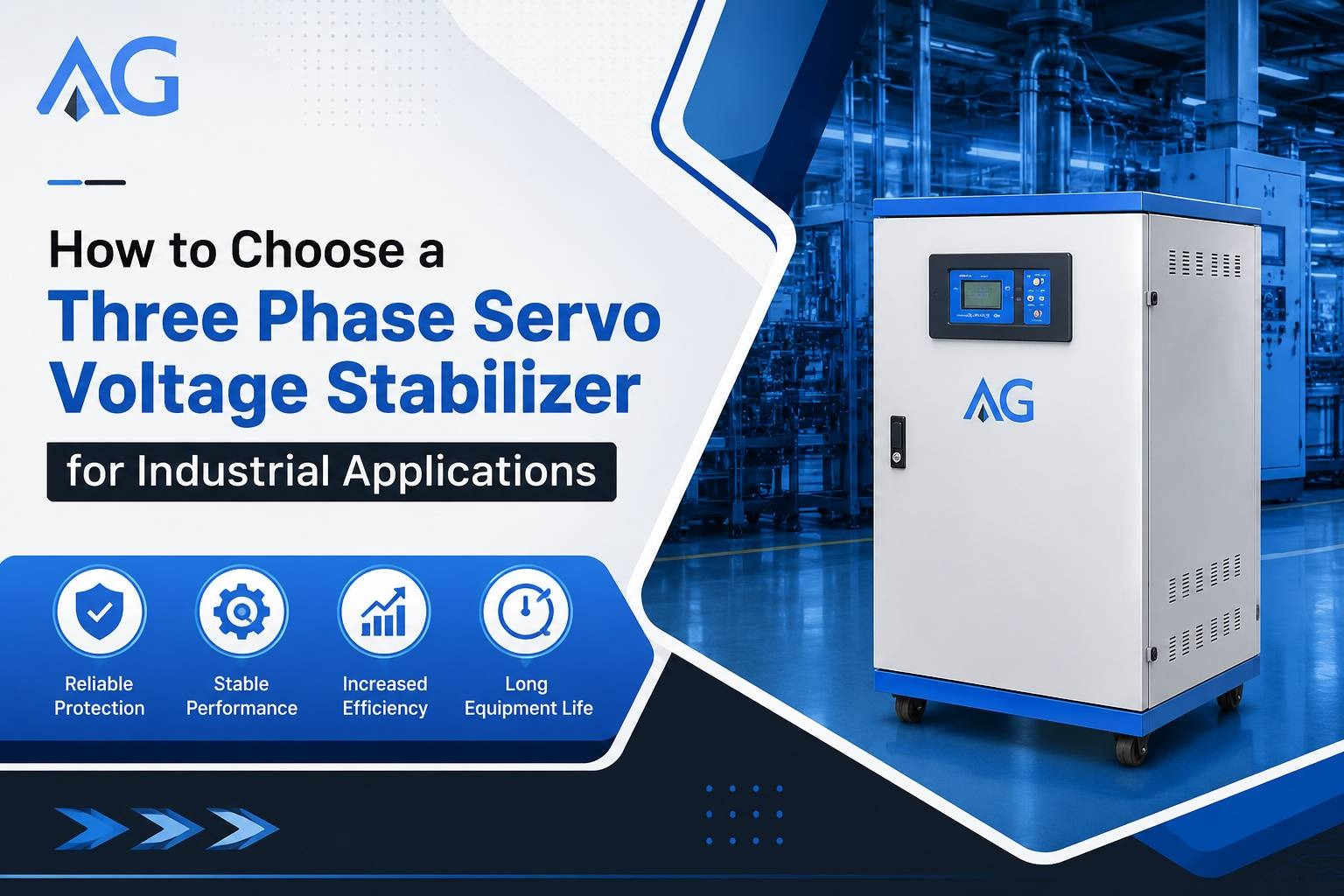
If you run a factory, workshop, or process plant, you already know what an unstable power supply does to your equipment. Motors overheat. CNC controllers reset mid-cycle. PLCs throw faults for no obvious reason. In most cases, the root cause isn't the machine — it's the voltage feeding it.
A three phase servo controlled voltage stabilizer in Thane is the standard fix for this problem across manufacturing units, process industries, and commercial buildings that run three-phase loads. But not every servo stabilizer is built the same, and buying the wrong capacity or type can leave your equipment just as exposed as having no stabilizer at all.
We've been manufacturing and supplying voltage stabilizers, static stabilizers, isolation transformers, and UPS systems from Thane since 1998. In this guide, we'll walk you through exactly how a three phase servo voltage stabilizer works, why industries need one, how to size it correctly, and what separates a servo stabilizer from a basic static unit — so you can make a confident, informed decision.
What Is a Three Phase Servo Voltage Stabilizer ?
A three phase servo voltage stabilizer is an automatic power conditioning device that uses a servo motor to continuously monitor and correct incoming voltage, delivering a stable, regulated output — typically within ±1% — even when the incoming supply swings well outside safe limits.
Unlike a basic stabilizer, a servo unit reacts in real time. The moment input voltage rises or falls, the servo motor drives a variable transformer (a "buck-boost" or roller-contact mechanism) to correct the output almost instantly, protecting connected machinery from both high-voltage stress and low-voltage under-performance.
How Does a Three Phase Servo Stabilizer Work ?
The servo motor sits at the core of the system. It continuously drives a variable autotransformer up or down in response to incoming voltage changes, correcting the output before it ever reaches your connected load. This closed-loop correction is what makes servo technology far more precise than relying, for example, on a fixed-tap or relay-based unit.
In practice, this means :
- • A microprocessor-based control circuit constantly senses input voltage
- • The servo motor adjusts the transformer winding contact position
- • Output voltage is held within a tight, pre-set tolerance band
- • Correction happens continuously, not in fixed steps
Why Do Industries Need a Servo Voltage Stabilizer ?
Industrial power supply is rarely stable — voltage sags during peak demand, spikes when heavy loads switch off, and fluctuates further with distance from the substation. Left uncorrected, this shortens equipment life, causes production downtime, and damages sensitive electronics.
A few real situations we see repeatedly with manufacturing clients :
- • CNC and machine tool controllers resetting or throwing errors during voltage sags, halting production mid-job
- • Motors and compressors running hot and burning out prematurely due to sustained under-voltage
- • Automation panels and PLCs behaving erratically when input voltage isn't within their tolerance band
- • Medical and lab equipment giving inconsistent readings because of unstable power
In every one of these cases, a properly sized three phase servo stabilizer removes the variable entirely, so your equipment always sees clean, regulated voltage regardless of what's happening on the grid.
Servo Stabilizer vs. Normal (Static) Stabilizer : What's the Difference ?
This is one of the most common questions we get from first-time buyers, and it matters more than most people expect.
| Factor | Servo Stabilizer | Static Stabilizer |
|---|---|---|
|
Correction method
|
Motor-driven, continuous | Relay/tap-based, stepped |
|
Precision
|
High (±1% typical) | Lower, corrects in fixed steps |
|
Response speed
|
Fast, real-time | Slower, step-change |
|
Best for
|
Sensitive/critical industrial loads | Lighter, less sensitive loads |
|
Moving parts
|
Yes (servo motor) | Fewer moving parts |
|
Maintenance
|
Periodic servicing recommended | Generally lower maintenance |
How Do I Choose the Right KVA Capacity ?
Short Answer : Add up the total connected load (in kW) of all equipment that will run through the stabilizer, convert to KVA using your load's power factor, and then add a safety margin of roughly 20–25% to account for future expansion and starting/inrush current.
Here's the step-by-step approach we recommend to clients :
- List every connected load that will draw power through the stabilizer — machines, motors, panels, lighting circuits, HVAC, etc.
- Convert kW to KVA using your equipment's power factor (KVA = kW ÷ power factor). Most industrial loads sit around 0.8, but check your motor/equipment nameplates for accurate figures.
- Account for starting current. Motors and compressors draw significantly more current at startup than at running load — this needs to be factored in, especially if several large motors start simultaneously.
- Add a safety margin. We generally recommend sizing 20–25% above your calculated running load, so the stabilizer isn't operating at its absolute ceiling day to day.
- Confirm your input voltage range. Industrial areas with weaker grid infrastructure may need a wider correction range (for example, 310V–470V vs. 360V–480V) — this affects which stabilizer variant suits your site.
- Get your site assessed. Since servo stabilizers are a customized item, the safest way to finalize capacity is a short technical consultation rather than guessing from a catalog figure.
Our three phase servo stabilizers are available from 5 KVA up to 500 KVA, with input voltage ranges of 310V–470V, 340V–470V, or 360V–480V depending on your site's grid conditions, and can be custom-built around your specific input voltage requirement.
Key Features to Look For in a Servo Stabilizer for Industrial Machines
Not all servo stabilizers on the market are built to the same standard. Before you buy, check that the unit includes :
- • High precision voltage regulation -output held within a tight band (±1% is a strong benchmark)
- • Advanced servo mechanism -a responsive servo motor that corrects fluctuations without delay
- • Overload and short-circuit protection -built-in safeguards, not optional add-ons
- • Surge/spike suppression -protection against sudden transient spikes
- • Single-phase prevention and reversal protection -critical for three-phase motor loads
- • High/low voltage auto cut-off -the unit should disconnect the load automatically outside safe limits
- • In-built bypass system -allows continued power supply during servicing
- • Alarm system -audible/visual alert when a fault condition occurs
- • Air-cooled design -for lower maintenance and reliable operation in industrial environments
- • Energy-efficient construction -minimizes power loss during correction, which shows up directly on your electricity bill
Where Servo Stabilizers Are Used ?
Three phase servo stabilizers aren't limited to factory floors. We regularly supply and install them for :
- • Manufacturing and industrial units - CNC machines, motors, compressors, and automated production lines
- • Commercial establishments - office complexes, shopping malls, and buildings with mixed three-phase loads
- • Medical and lab facilities - hospitals and diagnostic labs where sensitive equipment needs precise, stable voltage
- • Data centers and IT infrastructure - protecting servers and networking hardware from voltage-related damage
Common Mistakes to Avoid When Buying an Industrial Voltage Stabilizer
A few mistakes we see often, based on years of site visits and installations :
- • Undersizing capacity to save on upfront cost, then finding the unit maxed out within a year of adding new machinery
- • Ignoring input voltage range - buying a standard-range unit when the site actually experiences wider voltage swings
- • Skipping the site assessment and relying purely on a generic catalog spec
- • Choosing static stabilizers for sensitive loads where the slower, stepped correction isn't precise enough
- • Overlooking after-sales support servo stabilizers have moving parts and benefit from periodic servicing, so local support matters
Why Choose AG Power Systems ?
AG Power Systems has been based in Thane, Maharashtra since 1998, manufacturing and supplying servo stabilizers, static stabilizers, isolation transformers, and UPS systems to industrial and commercial clients across the region. Our three phase servo controlled voltage stabilizers are built with microprocessor-based controls, digital displays, and the protection features outlined above, and — because every site's power conditions are different — every unit can be customized to your specific input voltage requirement rather than sold as a one-size-fits-all catalog product.
If you're evaluating a servo stabilizer manufacturer in Thane, we're happy to walk through your site's load profile and recommend an appropriately sized unit, rather than pushing a standard model that may be over- or under-specified for your actual needs.
Conclusion
Choosing the right three phase servo voltage stabilizer comes down to three things: understanding your real load and starting current, matching the stabilizer's input voltage range to your site's actual grid conditions, and choosing a manufacturer who will size the unit for you rather than sell you a fixed catalog spec. Get these right, and a servo stabilizer will quietly protect your machinery and your uptime for years. Get them wrong, and you'll be back in the market within a couple of seasons.
If you're currently comparing options for a three phase servo controlled voltage stabilizer in Thane, our team can review your load requirements and recommend the right capacity and specification for your site — reach out for a free consultation.
Frequently Asked Questions
A three phase servo voltage stabilizer is an automatic device that uses a servo motor to continuously correct fluctuating three-phase input voltage, delivering a stable, regulated output (typically within ±1%) to protect connected industrial equipment.
It uses a microprocessor-based control circuit to sense input voltage changes, then drives a servo motor connected to a variable transformer to correct the output continuously and in real time, rather than in fixed steps.
Industrial power supply commonly fluctuates due to grid conditions and heavy load switching. Without correction, this shortens equipment life, causes CNC and PLC faults, and increases downtime — a servo stabilizer removes that variable.
Total your connected load in kW, convert to KVA using your equipment's power factor, account for motor starting current, and add a 20–25% safety margin. A site assessment gives the most accurate final figure.
A servo stabilizer uses continuous, motor-driven correction for high precision (around ±1%), while a normal/static stabilizer corrects in fixed steps via relays or taps, making it less precise but generally lower-maintenance.
AG Power Systems, based in Thane since 1998, manufactures and supplies three phase servo stabilizers from 5 KVA to 500 KVA, custom-built to your site's input voltage requirements. Contact us for a consultation and quote.